


After living in Bali for a year, I kept having the same talk with business owners, operators, and professionals from Australia and beyond.
They were excited about AI. They could see the value fast.
An insurance firm could review claims faster. A property group could pull insight from contracts, leases, and reports. A finance team could sort large sets of data without hours in spreadsheets. Admin teams could cut repeat work and focus on better tasks.
Then the talk would stop.
The owner would ask a simple question: Can we put our company data into this?
For many firms, the answer was not simple. Sensitive client files, financial records, legal documents, internal steps, and private business data cannot always go into a public AI tool hosted overseas. Privacy rules, data residency, client privacy, and internal governance all shape the choice.
What surprised me most was not the concern. It was that many people did not know there was another path.
Private AI for business offers that path.
Rather than forcing a choice between new tools and control, private AI lets firms use AI in a space built for security, governance, and ownership.
Why public AI is not always enough for business
Public AI tools have helped many people see what AI can do. They are easy to use and useful for daily tasks like drafting content, summarising general information, or brainstorming.
But business use is different.
When a company wants to use AI with real work data, the risk profile changes. The input is no longer a generic prompt. It may include:
- Customer records
- Legal agreements
- Insurance claims
- Medical or financial information
- Internal reports
- Board papers
- Product plans
- Staff records
- Sensitive correspondence
- Private processes
For many organisations, this data is under strict rules. Even if a public AI platform is secure, the business still needs to know where the data is processed, how it is stored, whether it may be used for training, who can access it, and which regions are involved.
That uncertainty can slow adoption. Teams know that AI for business could improve productivity, but they hesitate because the data question is still open.
This is where private AI changes the talk.
What private AI means
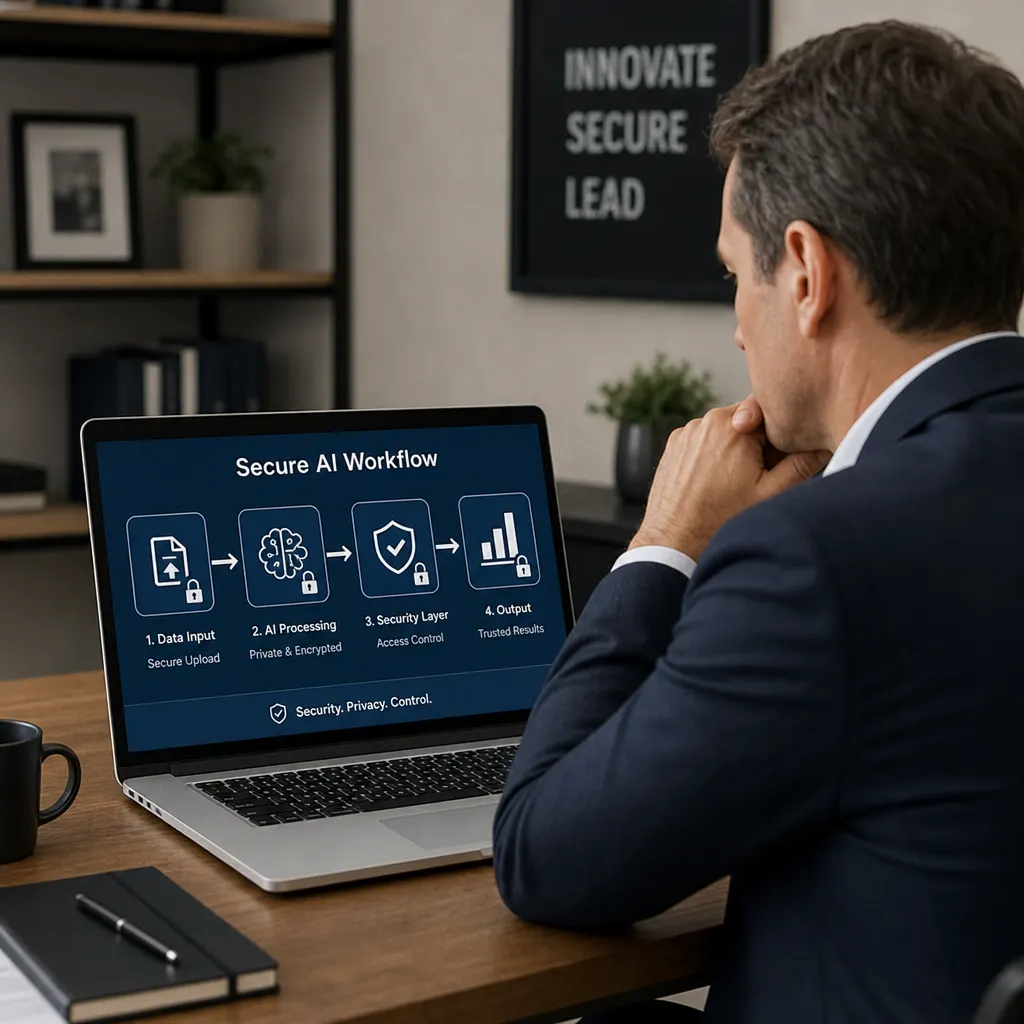
Private AI is artificial intelligence used in a controlled environment for one organisation. Instead of sending sensitive business information into a public platform, the model runs in infrastructure chosen and managed by the business.
That infrastructure may be:
- On-premise servers
- A private cloud
- A dedicated cloud instance
- A local or region-specific cloud setup
- A hybrid setup that mixes internal systems with controlled cloud tools
The main idea is simple: the organisation keeps control over its data, access rules, workflows, and deployment model.
Private AI does not mean a business must build a model from zero. In many cases, it can use open-source models, commercial models, or enterprise models and place them in a private setup. The value comes from the right model, the right data rules, and the right links to business systems.
In practice, private AI for business lets leaders ask: How can we use AI without losing privacy, compliance, or trust?
Why private AI matters now
Artificial intelligence is moving from tests into real work. Businesses are no longer only asking AI to write a post or summarise a public article. They want AI to support daily jobs.
That may include reading internal files, comparing contracts, answering staff questions from company policies, drafting reports, reviewing client files, or spotting patterns in work data.
These are not light use cases. They need the information that makes a business run.
Without private options, many organisations stay stuck. They avoid AI or keep it to low-risk tasks. That means they miss gains in speed, insight, and service while others move ahead.
Private AI gives firms a way to move ahead with care. It helps close the gap between what is possible and what is allowed.
How private AI supports business value
The value of private AI is not just control. Control makes harder use cases possible.
When a business trusts the setup, it can use AI on higher-value work.
Document review and summary
Many businesses live on documents. Insurance firms, legal teams, property groups, advisers, consultants, healthcare providers, and government contractors all handle large amounts of written material.
Private AI can help teams:
- Summarise long documents
- Pull key terms from contracts
- Compare versions of agreements
- Spot missing details
- Group documents by topic or risk tier
- Draft short briefings for review
The goal is not to remove human judgement. It is to cut the time spent reading, sorting, and pulling out data by hand.
Internal knowledge search
Most businesses have useful facts spread across drives, intranets, email archives, PDFs, policies, and databases. Staff often waste time looking for the right answer or asking a colleague for something that already exists.
A private AI assistant can connect to approved internal knowledge sources so staff can ask plain-language questions and get useful, clear answers.
For example:
- What is our process for onboarding a new client?
- Which policy applies to this claim?
- Summarise the latest project notes.
- What are the key terms in this agreement?
Because the system is private, access can match internal permissions. Staff should only see information they are allowed to see.
Financial and operational analysis
AI can help leaders read information faster. A private AI system can support reports, forecasts, budgets, invoices, work metrics, or performance data.
It can help teams spot trends, explain odd results, draft management summaries, or create questions for deeper review.
This is very useful when people work with large sets of semi-structured data. AI can turn raw data and written notes into clearer insight.
Customer service and support
Private AI can help customer teams get approved information quickly. It can suggest replies, summarise customer history, sort requests, or guide staff through complex steps.
For regulated industries, this matters. A public chatbot may not fit sensitive customer work, but a private AI solution can be built with stricter guardrails, approved knowledge sources, and audit steps.
Reducing repetitive administration
Every business has repeat work that drains time. Staff copy data between systems, summarise calls, draft routine emails, check documents, format reports, and answer the same internal questions again and again.
Private AI can automate or assist with these tasks while keeping sensitive information inside a controlled space. Over time, this can give teams back hours and let people focus on work that needs experience, judgement, and relationships.
Private AI versus public AI
The difference between private and public AI is not just where the software runs. It is about control.
With public AI tools, a business uses a shared external platform. That may be fine for general work, but it may not meet the needs of sensitive business data.
With private AI, the business can decide:
- Where data is processed
- Where data is stored
- Who can access the system
- Which models are used
- What the model can retrieve
- How outputs are logged
- How usage is watched
- How security rules are applied
- Whether data stays in one country or one region
For many organisations, this level of control makes enterprise AI solutions workable.
This is not about rejecting public AI. Many companies may use both. Public AI may fit low-risk tasks, while private AI supports sensitive workflows and private information.
The role of data residency and compliance
Data residency is one of the biggest reasons firms explore private AI. If a business must keep data in one region, or if clients expect that, an overseas public AI platform may create doubt.
This matters for businesses across Australia, Asia-Pacific, Europe, and other regions with privacy and data rules.
Private AI can be set up around those needs. For example, a business may choose local infrastructure, apply tight access rules, and keep logs for audit use.
But private AI is not compliant just because it is private. Good governance still matters.
A responsible setup should think about:
- Privacy duties
- Industry rules
- Client contract terms
- Internal security rules
- Records management
- Human review steps
- Risk tiers for use cases
The best move is to bring legal, compliance, IT, and business teams in early. AI is not only a tech choice. It is also an operations and governance choice.
Key parts of a private AI solution
A good private AI setup usually has more than a model. The model is only one part.
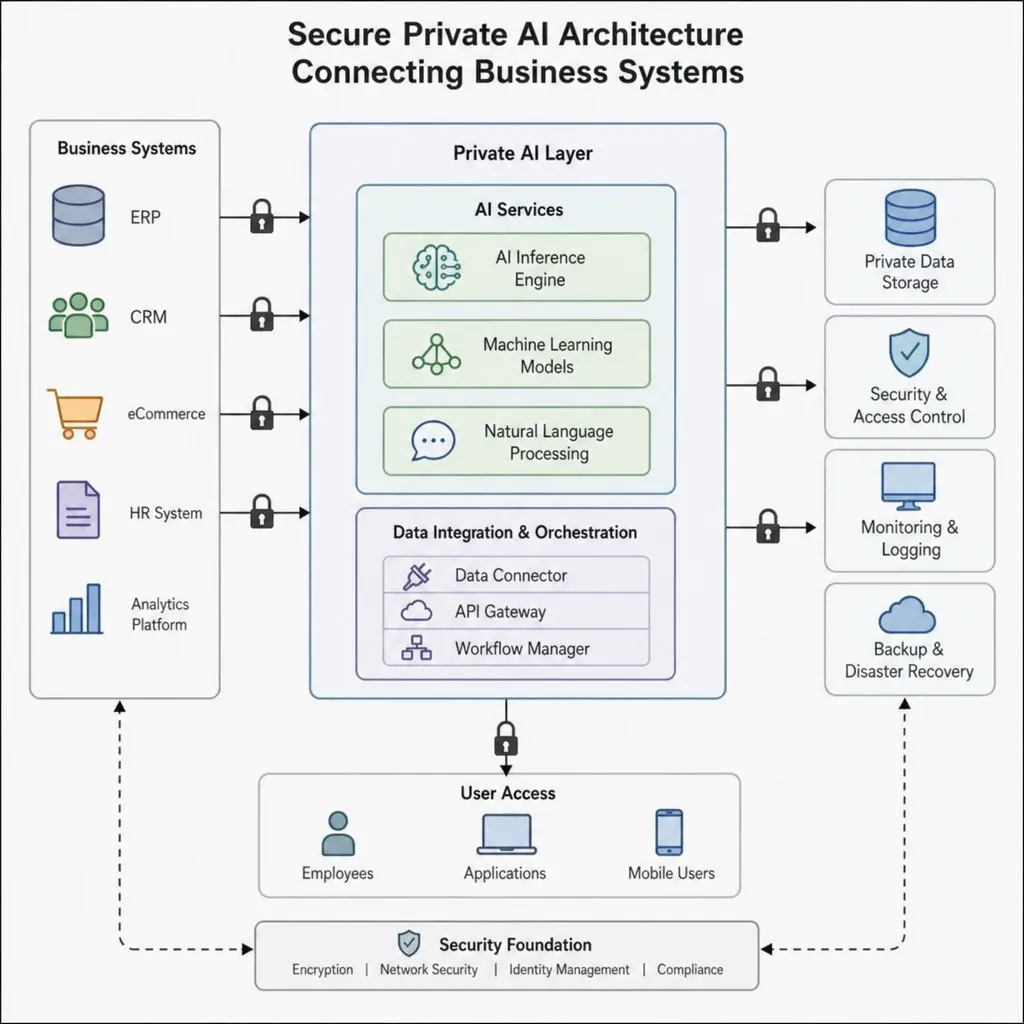
A full solution may include:
- A secure setup: The infrastructure where the AI runs.
- A chosen AI model: The language model or special model used for the task.
- Data links: Approved links to documents, databases, or internal systems.
- Access controls: Rules that decide who can use the system and what they can see.
- Prompt and reply control: Rules that guide how people use the model.
- Audit logs: Records of use, outputs, and system activity where needed.
- Human review steps: Checks that keep key decisions accountable.
- Monitoring and updates: Ways to measure results and improve the system.
Businesses often focus only on the model. In truth, the full setup is what decides if the system is safe, useful, and easy to grow.
Best use cases to start with
Not every workflow should be automated right away. The best first use cases are useful, repeatable, and low enough in risk to test safely.
Good starting points may include:
- Internal policy search
- Document summary
- Meeting note structuring
- Report drafting
- Contract clause extraction
- Customer enquiry sorting
- Knowledge base help
- Admin workflow support
Avoid starting with use cases where AI output would make final choices about people, money, access, legal rights, or safety without strong human review. These areas can still benefit from AI, but they need more care.
A strong private AI plan starts with simple wins. Once trust grows, the business can move into more complex work.
Questions to ask before implementing private AI
Before investing in Private AI for business, leaders should be clear on the goal and the limits of the project.
Useful questions include:
- What problem are we solving? AI should help with a real work issue, not just follow a trend.
- What data will we need? Find out if the use case needs public, internal, private, or regulated data.
- Where must the data be processed and stored? Think about residency, client needs, and policy rules.
- Who should have access? Access should match roles, duties, and current permissions.
- How accurate must it be? Some tasks can use draft output. Others need strict checks.
- Where do people need to review it? AI should support accountable decisions, not hide them.
- How will we measure success? Track time saved, speed, quality, customer experience, or lower manual work.
- How will we maintain it? AI systems need watch, updates, and governance as business data changes.
These questions help keep a private AI project from becoming a tech test with no clear business result.
Common myths about private AI
Private AI is often misunderstood. Some owners think it is only for large companies with big budgets. Others think it needs a brand-new model built from zero.
In many cases, neither is true.
Private AI can be built at different sizes. A smaller business may start with a focused internal assistant linked to a small set of documents. A larger business may deploy a wider platform tied to many systems and stronger security controls.
Another myth is that private AI removes all risk. It does not. AI can still give wrong, partial, or misleading output. It can still reflect poor source data. It can still be misused if access rules and policies are weak.
Private AI lowers some risks linked to data exposure and control, but it still needs good governance, training, and review.
Building an AI-ready business
Technology alone will not unlock the full value of AI. Businesses also need to be AI-ready.
That means building the right setting for AI to work well:
- Clean and organised data
- Clear internal processes
- Clear ownership of systems and information
- Staff training on proper use
- Policies for sensitive data
- A culture of safe testing
- Leadership support for change
AI works best when it is dropped into a business that knows how it works. If processes are unclear or data is messy, AI may just make the confusion faster.
Before deploying enterprise AI solutions, businesses should check where information lives, who owns it, and which processes are best to improve.
The human role in private AI
One of the most important ideas in any AI project is that humans stay accountable.
Private AI should not be seen as a replacement for skill. It is better seen as a tool that helps people work with information more effectively.
A claims specialist still brings judgement. A property expert still understands deal flow and market context. A finance expert still checks assumptions. A manager still makes decisions based on experience, ethics, and business goals.
AI can speed up prep, analysis, and search. Humans bring context, responsibility, and final judgement.
The best results come when AI is built around people, not pushed on them.
A practical roadmap for getting started
For businesses thinking about private AI, the first step does not need to be a large change program. A staged plan often works better.
Step 1: Find high-value friction
Look for tasks that are repeat, document-heavy, slow, or tied to searching for information. These are often the best early AI wins.
Step 2: Sort the data
Work out what type of data the use case needs. Is it public, internal, private, client-sensitive, or regulated? This shapes the setup.
Step 3: Choose a small pilot
Start with one narrow use case and a small user group. A focused pilot makes results easier to measure and risk easier to manage.
Step 4: Pick the right setup
Decide if the solution should run on-premise, in a private cloud, in a dedicated environment, or in a hybrid model. The right choice depends on security, compliance, and speed needs.
Step 5: Add governance early
Set rules for use, access, review, logging, escalation, and ownership. Governance should not wait until the system is live.
Step 6: Train users well
Staff need to know what the AI system can do, what it cannot do, and how to check its output. Training is key for safe use.
Step 7: Measure and improve
Track time saved, user feedback, output quality, and process impact. Use what you learn to improve the system before you scale it.
Why private AI may become a competitive edge
Businesses that solve the data trust problem can move faster than those that stay stuck.
Private AI lets organisations use their own knowledge, documents, and work data in ways public tools may not allow. That can lead to more relevant output, better internal speed, and stronger decision support.
The edge is not just having AI. Over time, almost every business will have some form of AI. The edge comes from using AI safely in the exact information, workflows, and skill set that make a business unique.
That is where private AI becomes powerful.
It helps businesses move beyond generic prompts and into practical, controlled intelligence that fits how they really work.
Moving from curiosity to capability
Many owners already know that AI for business is not a far-off idea. They can see the upside. What holds them back is not a lack of ideas. It is the need to protect sensitive information and keep control.
Private AI deals with that barrier.
It gives organisations a way to explore automation, analysis, and smart help without sending private data into systems they do not fully trust.
For insurance, property, finance, professional services, and many other sectors, that may be the difference between talking about AI and actually using it.
If your business is excited about AI but careful about privacy, the next step is not to ignore the chance. It is to explore a private, secure, and well-governed path that fits your duties and goals.
The potential is already there. Private AI is how more businesses can unlock it well.
Q&A
Question: What exactly is private AI, and how does it differ from public AI for businesses?
Short answer: Private AI is an AI system used in a controlled space your organisation runs, such as on-premise, a private or dedicated cloud, a local or region-specific setup, or a hybrid model. The business chooses where data is processed and stored, who can access it, which models are used, what the model can reach, and how use is logged and watched. Public AI is a shared outside platform for low-risk, general tasks. Private AI is built for security, governance, and ownership so you can use sensitive data in a safe way. You do not need to build a model from zero. You can use open-source, commercial, or enterprise models in your own controlled space.
Question: Where does private AI deliver the most value in day-to-day operations?
Short answer: Control opens up higher-value use cases that depend on sensitive internal information. Common value areas include:
- Document review and summary, such as pulling key terms, comparing versions, finding gaps, and drafting briefings
- Internal knowledge search, with plain-language answers from approved policies, procedures, and archives and access that matches permissions
- Financial and operational analysis, such as spotting trends, explaining odd results, and drafting management summaries
- Customer service and support, such as suggested replies from approved knowledge and help with complex processes under tighter guardrails
- Reducing repetitive administration, such as summaries, sorting, formatting, and routine correspondence. AI speeds up prep and retrieval, while humans keep context, judgement, and accountability.
Question: What are sensible first use cases, and which should we avoid at the start?
Short answer: Start with useful, repeatable, lower-risk work where the results can be checked safely, such as internal policy search, document summary, meeting note structuring, report drafting, contract clause extraction, customer enquiry sorting, knowledge base help, and admin workflow support. Avoid starting where AI output would make final decisions about people, money, access, legal rights, or safety without strong human review. Begin with a small pilot, measure the impact, improve it, and then expand into more complex work as trust grows.
Question: How do we stay compliant with privacy, data residency, and governance needs?
Short answer: Private AI can be set up for residency and compliance by choosing local or region-specific infrastructure, matching access to internal permissions, and keeping audit logs. But private does not mean compliant by default. You still need to handle privacy duties, industry rules, client contract terms, internal security rules, records management, risk tiers for use cases, and human review points. Bring legal, compliance, IT, and business teams in early, and set governance before launch: acceptable use, access rules, review steps, logging, escalation, and ownership.
Question: Do we need to build our own model or be a large enterprise to use private AI?
Short answer: No. Many organisations use existing open-source or commercial models in a controlled space and start small, for example with an internal assistant linked to a small document set, and then scale. A practical roadmap is: 1) find high-value friction, 2) sort the data, 3) choose a small pilot, 4) pick the right setup, 5) add governance early, 6) train users well, and 7) measure and improve. This staged path works for small businesses and large enterprises while keeping control, compliance, and human accountability.
